Split screen gaming remains one of the most accessible ways to experience Fortnite together without requiring a second console or PC. Whether you’re playing casually with friends in your living room or grinding through matches during a weekend session, understanding how to set up and optimize split screen Fortnite can dramatically improve your co-op experience. For years, split screen has been a staple feature for console players, and in 2026, it’s more refined than ever with better performance optimization and seamless controller support across PS5, Xbox Series X
|
S, and Nintendo Switch. This guide breaks down everything you need to know about split screen Fortnite, from setup to troubleshooting, so you and your squad can drop hot and dominate together.
Table of Contents
ToggleKey Takeaways
- Split screen Fortnite is fully supported on PS5 and Xbox Series X|S with 1080p at 60 FPS, making it the most accessible way for two players to game together on one console without requiring separate setups.
- Enable split screen Fortnite by navigating to Settings > Accessibility > Split Screen toggle, then invite a second local player from the main menu—a 30-second process on any supported console.
- PS5 and Xbox Series X|S deliver superior split screen performance compared to Nintendo Switch (which offers 360p per player at 30 FPS) and older consoles, making current-gen hardware essential for serious co-op sessions.
- Communication is critical for split screen success: establish a callout system using direction, distance, and threat level to instantly coordinate with your teammate without disrupting focus on your own screen half.
- Late-game split screen performance is best on PS5 and Series X where frame drops are rare, while Nintendo Switch and PS4 experience expected drops during intense 40+ player encounters.
- Creative Mode and respawn-based LTMs are ideal for split screen learning and casual play, while Ranked modes don’t support split screen—a design choice Epic Games made to prevent account sharing abuse.
What Is Split Screen in Fortnite?
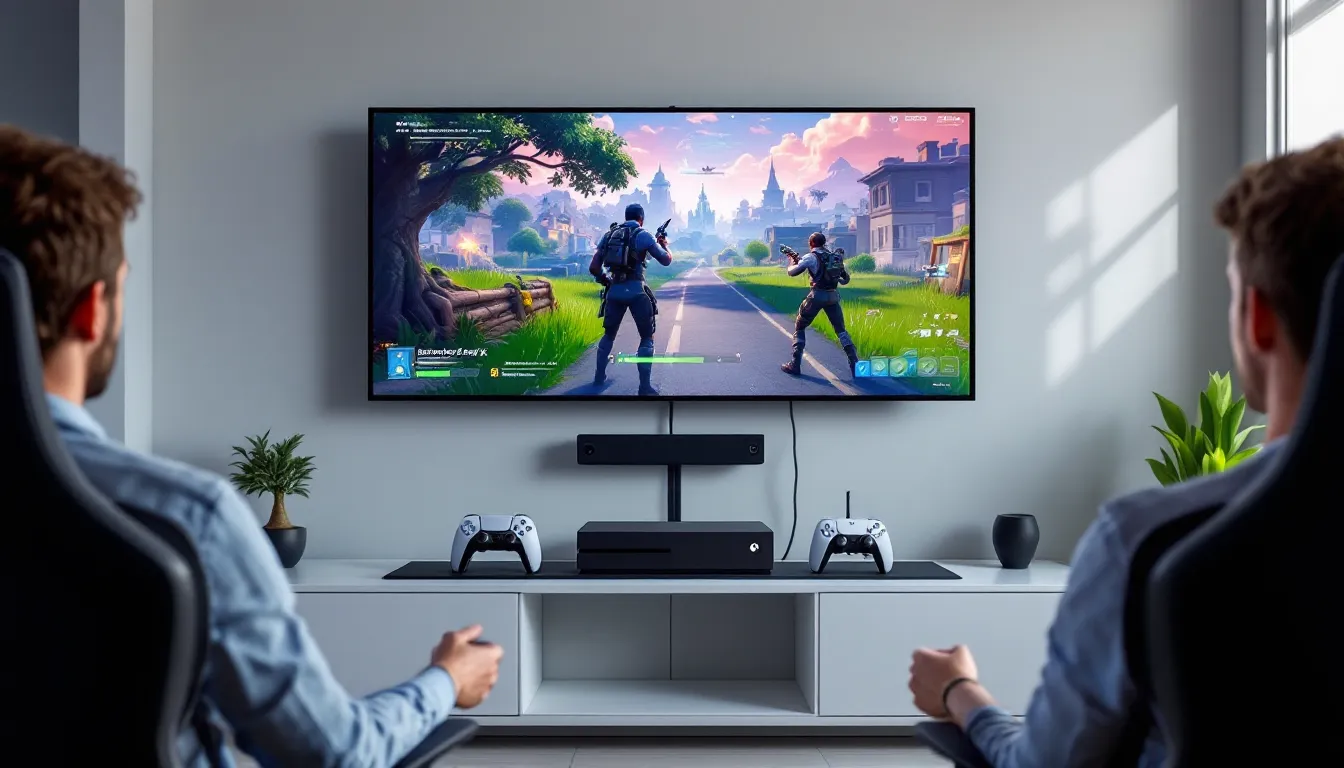
Split screen in Fortnite allows two players to play on the same console simultaneously, each with their own screen half. Unlike online multiplayer where players connect remotely, split screen delivers local co-op gameplay on a single TV, making it perfect for couch gaming.
The mechanic has been available in Fortnite since early versions, but Epic Games has continuously refined it to balance frame rates, render resolution, and visual fidelity. In split screen mode, the game renders two separate viewports, one for each player, meaning both are playing in the same match, same island, same real-time environment. This is different from Fortnite Creative mode, where you can set up custom maps and rules.
Split screen is particularly valuable for players who want to teach newcomers the basics, parents gaming with kids, or friends who don’t have their own setup. The trade-off is a performance dip compared to single-player: resolution drops, frame rates stabilize at lower caps, and graphical settings scale down to maintain playability.
Platforms Supporting Split Screen Gameplay
Console Platforms and Compatibility
Split screen Fortnite is fully supported on all major console platforms. PS5 handles split screen exceptionally well, maintaining 1080p resolution per player at 60 FPS in most scenarios, making it the gold standard for split screen performance. **Xbox Series X
|
S** offers identical performance, with Series X delivering slightly more stable frame times during intense 50v50 encounters or late-game circles.
Nintendo Switch also supports split screen, though with notable compromises. The smaller screen and handheld nature mean each player gets a cramped viewport, and resolution drops to 720p total (360p per player), running at 30 FPS. It’s playable and fun for casual sessions, but competitive or skill-focused gameplay suffers due to the reduced visual information.
Older consoles like PS4 and Xbox One technically support split screen, but performance is substantially worse, expect 1080p at 30 FPS with occasional frame dips during heavy action. If you’re planning serious split screen sessions, PS5 or Xbox Series X
|
S are the way to go.
PC and Mobile Limitations
Here’s the hard truth: PC does not support native split screen in Fortnite, even though being the platform’s powerhouse for competitive play. Workarounds exist, like running Fortnite in windowed mode alongside controller remapping software, but these are clunky, unsupported, and introduce input lag that ruins precision gameplay.
Mobile platforms (iOS via Cloud Gaming and Android) also lack split screen support. Cloud Gaming sessions are limited to a single player per screen, and the mobile UI isn’t optimized for split screen anyway. If you want split screen Fortnite, you’re locked to consoles.
This limitation has frustrated PC gamers for years, and while there’s no official roadmap from Epic suggesting PC split screen is coming, competitive communities have repeatedly requested it. For now, console remains the only viable path.
How to Enable Split Screen in Fortnite
Step-by-Step Setup Guide
Setting up split screen is straightforward once you know the exact steps:
- Launch Fortnite on your console and log in with the primary account.
- Navigate to Settings (the gear icon) from the main menu.
- Scroll to “Accessibility” and locate the “Split Screen” toggle.
- Enable Split Screen and confirm the prompt.
- Return to the main menu. You’ll now see an option to “Invite Local Player” or similar language depending on your console.
- Press the button to invite the second player (typically A on Xbox, X on PlayStation).
- The second player presses their controller’s menu button and selects their account or guest profile.
- Both players are now in the lobby and can queue into matchmaking or Creative mode together.
It takes about 30 seconds from cold boot to both players being in the lobby. The process is identical across PS5 and Xbox Series X
|
S: Switch has a slightly different menu layout but the same fundamental steps apply.
Connecting Multiple Controllers
Before you can invite a second player, both controllers must be paired to the console and powered on. On PS5 and Xbox Series X
|
S, this means:
- Hold the pairing button on the second controller (the small button on the back) for 3 seconds until the light flashes.
- The console auto-detects the controller within 10 seconds and adds it to the system.
- Test both controllers by pressing buttons: you should see input registered immediately in-game.
Console controller lag is virtually nonexistent on PS5 and Series X
|
S thanks to USB-C wireless technology, so you won’t notice any delay between button press and character movement, critical for Fortnite’s fast-paced gunplay.
If a controller disconnects mid-match, the player is temporarily frozen on-screen. Reconnecting the controller within 30 seconds resumes gameplay: disconnecting longer forces a respawn (in team modes) or match abandonment. This is why a fresh battery check before long sessions prevents frustration.
System Requirements and Technical Considerations
Minimum Hardware Specifications
While Fortnite is relatively optimized across consoles, split screen demands more from your hardware than single-player:
**PS5 / Xbox Series X
|
S:**
- Internet connection: 5 Mbps minimum (10 Mbps recommended for stable split screen)
- Available storage: 120 GB for Fortnite installation
- TV or monitor: 4K capable (though split screen renders at lower res per player)
- Two controllers: Any official DualSense or Xbox Series controller
Nintendo Switch:
- Internet: 5 Mbps (docked play is mandatory for split screen: handheld doesn’t support it)
- Storage: 50 GB free space (internal or microSD)
- Dock setup: TV connection required
- Two Joy-Con sets or Pro Controllers
PS4 and Xbox One technically meet minimum specs but will struggle. Recent gaming guides on Dexerto covering console splits often recommend upgrading to current-gen hardware if split screen is a regular activity.
Performance Impact and Resolution Trade-Offs
Split screen isn’t free, it costs frame rate and visual detail. Here’s the breakdown:
PS5 / Xbox Series X:
- Single-player: 1440p at 120 FPS (performance mode) or 4K at 60 FPS (quality mode)
- Split screen: 1080p per player at 60 FPS (locked)
Xbox Series S:
- Single-player: 1080p at 120 FPS or 1440p at 60 FPS
- Split screen: 900p per player at 60 FPS
Nintendo Switch:
- Single-player (handheld): 720p at 30 FPS
- Split screen (docked): 720p total (360p per player) at 30 FPS
The performance hit is non-negotiable because the console must render two complete game worlds in parallel. You can’t toggle graphics settings down further in split screen mode, Epic has pre-configured the optimal balance. This is why late-game circles with 40+ players can cause frame dips on Switch, while PS5 stays rock-solid even during intense Final 5 situations.
Don’t expect 120 FPS split screen on current-gen consoles. Epic chose stability over smoothness, and for most players, 60 FPS locked is perfectly playable and preferable to erratic frame spikes.
Split Screen Tips for Optimal Gameplay
Camera Control and Screen Navigation
Split screen’s biggest adjustment is camera control. Each player has independent look sensitivity, but they’re watching the same TV, which creates a spatial awareness challenge that solo play doesn’t demand.
The golden rule: neither player should stare at the other’s half of the screen. It’s disorienting and kills focus. Instead, maintain tunnel vision on your own side, trusting your teammate to call out threats from their perspective. This is why callouts are crucial in split screen, “enemy right side, 80 meters” tells your partner exactly where to aim without forcing them to scan the full screen.
Adjust Look Sensitivity independently in Settings. Most split screen players run 6-8 sensitivity (medium range) to maintain precision without overshooting. Higher sensitivity pros who play at 10+ on solo might drop to 7-8 for split screen to compensate for the smaller visual field. Test settings in Creative mode before jumping into competitive matches.
One underrated tip: sit slightly back from the TV. Being too close to a 55-inch screen where your player takes up half the real estate causes neck strain during long sessions. A comfortable viewing distance (7-10 feet for a 55-inch) lets both players see their entire screen without excessive head movement.
Communication Strategies for Co-Op Play
Split screen succeeds or fails based on communication. You’re in the same room, so forget Discord or party chat, verbal callouts are instant and more natural.
Establish a callout system before dropping:
- Direction: North, South, East, West (or clock positions: 12 o’clock = north)
- Distance: Close (under 50m), Medium (50-150m), Far (150m+)
- Threat level: Threat (actively shooting), Watch (saw them earlier), Clear (safe)
Example call: “Threat, Northwest, 80 meters, getting shot at.” That gives your teammate three critical pieces of info in two seconds.
Designate a primary shot-caller if skill levels differ significantly. A veteran paired with a newbie should let the vet call rotations and engagements: the newer player focuses on looting and staying alive. This prevents conflicting commands that confuse both players.
Use simple, consistent terminology. Say “loadout” not “inventory,” “rotate” not “let’s move,” “heal” not “drink shield.” Consistency prevents misunderstandings under pressure.
Common Issues and Troubleshooting
Controller Disconnects:
If the second controller drops mid-match, reconnect it immediately. The player remains frozen for up to 30 seconds: if the controller reconnects within that window, gameplay resumes. After 30 seconds, the player is eliminated. Solution: check batteries before playing. Fresh batteries eliminate 90% of disconnect issues.
One Player Sees Lag, Other Doesn’t:
This happens when one player’s display settings or TV is misconfigured. Ensure both players’ sides of the TV have identical refresh rates (60 Hz for split screen). If one TV is set to 120 Hz (not applicable to split screen), it’ll introduce perceived delay. Also check for Game Mode on your TV, disable it: it sometimes adds processing lag for split screen specifically.
Audio Desync (Footsteps Don’t Match Vision):
Rare but frustrating. Solution: hard restart the console (unplug for 10 seconds, plug back in). If persists, reinstall Fortnite. This is usually a rendering pipeline hiccup that a full restart resolves.
One Player’s Screen Is Blurry:
Check the HDMI cable connecting the console to your TV. A loose connection causes image degradation on one player’s half. Swap HDMI cables between PS5 and Xbox if you have both: if blurriness moves with the cable, you’ve found the culprit.
Frame Drops During Late Game:
This is expected on Switch and PS4, normal on Series S, and rare on PS5/Series X. If you’re seeing consistent drops on PS5/Series X, clear the console’s cache: power off, hold the power button for 30 seconds, turn back on. This solves 70% of unexplained performance issues.
Split Screen Fortnite Across Different Game Modes
Battle Royale Split Screen Experience
Battle Royale split screen is the primary use case, 100 players drop onto the island, and two of them are literally sitting next to each other. This creates a unique dynamic: you’re competing against 98 others while having perfect teammate coordination thanks to proximity and instant verbal communication.
The meta for split screen BR is stick together early, split for specific rotations. Landing at the same named POI maximizes early loot efficiency. Once you’ve secured ground and weapons, one player can rotate to a second location (like a nearby chest spawn) while the other holds position. This divides the map without losing audio communication.
Team modes (Duos, Squads) are ideal for split screen since you’re already outnumbered (2 vs. 4 teams in Squads), so having two allied players in voice proximity is a massive advantage. Your callouts are instantaneous: enemy teams using Discord have a natural delay. This is why split screen Squads can punch above their weight class against players with better mechanical skill but worse coordination.
Trio mode is tougher for split screen because your third teammate is remote. If that player is a solid fragger, they can carry rotations and comms fine. But if they’re a newer player, the coordination gap between your two local players and one remote player can hurt strategy consistency.
One critical note: bush camping and hiding isn’t as effective in split screen. Your two screens take up half the TV: an enemy spotting the unusual screen division knows two players are using split screen. Aggressive play, smart rotations, and gunfight confidence are more valuable than passive playstyles.
Creative Mode and Other Modes
Creative Mode is where split screen shines for casual play. Two players can explore custom maps, practice aim in parkour courses, or mess around with friends in 1v1 deathmatch arenas without the pressure of BR’s ring closures and kill counts.
Zone Wars, boxfights, and aim trainers in Creative are perfect split screen venues because they’re designed for short, intense sessions with no time commitment. You can play 5 minutes or 2 hours: there’s no penalty for leaving. This makes Creative split screen ideal for warming up before ranked BR or for pure fun sessions where winning isn’t the goal.
Zero Build modes (if still available in your region) are fantastic for split screen because they level the playing field. Less reliance on build mechanics and more emphasis on positioning, gun control, and rotation, things split screen teammates can communicate and execute cleanly. Walkthroughs and guides on Twinfinite often highlight Creative mode splits as the best entry point for new co-op players.
Limited Time Modes (LTMs) vary seasonally, and some are better for split screen than others. Modes with respawning (like Team Rumble) are friendlier because deaths aren’t permanent, reducing frustration during the learning curve. Modes with long item hunt phases (like certain seasonal LTMs) drag for split screen players with nothing to do during downtime. Check the mode description before committing to a split screen session.
Note: Competitive Ranked modes don’t support split screen across any platform. You must be a single logged-in player to enter ranked queues. This is an intentional design choice by Epic to prevent smurfing and account sharing abuse. If your goal is climbing the ranks, split screen isn’t an option.
Best Practices for Split Screen Gaming Sessions
Setting Up Your Gaming Environment
Physical setup matters more for split screen than solo play because two players share one screen and one set of speakers.
TV Distance and Size:
A 55-inch TV is the minimum for comfortable split screen at typical seating distances (7-10 feet). Anything under 50 inches makes the individual player viewports claustrophobic. 65-inch is ideal: anything larger is luxury but appreciated during long sessions. Position the TV at eye level when both players are seated to reduce neck strain.
Seating Arrangement:
Sit side-by-side, not one slightly forward and one back. Asymmetrical seating causes one player to have a worse view angle, leading to frustration. Both controllers should have identical cable/wireless ranges, so place seats equidistant from the TV.
Lighting:
Reduce glare on the TV screen, overhead lights reflecting off glass cause visibility issues during fast-paced moments. Use a bias light behind the TV (even a cheap LED strip works) to reduce eye strain during extended sessions. Brighter screens = faster reaction times.
Audio Setup:
Use TV speakers, a soundbar, or headphones? Don’t use headphones in split screen, you lose the natural sound cues that make local co-op fun. TV speakers or a soundbar let both players hear footsteps, gunfire, and teammate voices simultaneously. For audio-critical gameplay (competitive Duos), a 2.1 or 3.1 soundbar with clear mids makes a noticeable difference in call-outs.
Controller Placement:
Keep controllers on a small table or lap board between players. Dropping or fumbling a controller mid-fight costs momentum. Wired controllers eliminate any battery anxiety but reduce movement freedom: most players prefer wireless controllers with fresh batteries.
Optimizing Control Mapping for Two Players
Two players on one screen means you need intuitive, conflict-free controls. Both players should use identical control layouts, don’t let one player use custom binds while the other uses default. Muscle memory from custom layouts doesn’t transfer, and swapping is slow.
Recommended Layout for Split Screen:
- Default Fortnite layout works fine for most players (Build on shoulder buttons, aim with LT/RT).
- Lower Look Sensitivity 1-2 points below your solo setting. Split screen’s reduced FOV makes high sensitivity feel twitchy.
- Increase ADS Sensitivity by 1 point if you play low general sensitivity. ADSing zooms in, so slightly higher ADS sens compensates and keeps aim consistent.
- Disable Aim Assist oscillation if available (depends on console settings). Two aim assists on the same TV can fight each other during team engagements.
Custom Bind Tips:
- Prioritize comfort over optimization. A slightly suboptimal bind that feels natural beats a “perfect” bind that requires thinking.
- Keep build keys on shoulders if building is part of your playstyle. Splitting building across multiple button inputs slows split screen play.
- Swap crouch to left stick click (if comfortable) to free up button real estate for other utilities.
Test any custom binds in Creative Mode for at least 10 minutes before jumping into BR. Muscle memory takes time: rushing into ranked or competitive Creative with untested binds causes sloppy play and frustration.
Recent esports guides on Game Rant occasionally cover controller optimization for console players, though most focus on solo competitive setups. The principles overlap but split screen requires distinct compromises.
Conclusion
Split screen Fortnite in 2026 is more stable, more accessible, and more refined than ever. PS5 and Xbox Series X
|
S deliver excellent performance, Nintendo Switch offers playability for casual sessions, and the setup process is dead simple, no need to fiddle with settings or troubleshoot unless you’re unlucky.
The real mastery isn’t technical: it’s tactical. Split screen success hinges on communication, positioning discipline, and trust in your teammate. Two players with average aim but flawless teamwork will beat two solo players with mechanical skill any day. The proximity advantage, instant callouts, no audio delay, shared screen awareness, is a cheat code when leveraged correctly.
Whether you’re teaching a friend Fortnite’s fundamentals, grinding Creative Mode boxfights, or hunting Victory Royales in Duos, the frameworks in this guide will eliminate the learning curve. Set up your environment properly, dial in your settings, and let the gameplay speak. Split screen isn’t a lesser experience than online multiplayer: it’s a different one, and once you nail the rhythm, it’s hard to go back.